Vitamin B6 HPLC Fluorescence Response Enhanced by Post Column Photochemical UV Irradiation
By Henry Joshua
Aura Industries Inc. • 545 Eighth Ave., Suite 5W, • New York, NY 10018
Phone: 212-
Abstract:
A simple, reliable, sensitive and selective high performance liquid chromatographic
method for the determination of vitamin B6 has been developed using post-
Introduction:
Vitamin B6 whose primary biologically active form is pyridoxal 5'-
Discussion:
There are important advantages of the PHRED™ method over the Rybak method. The PHRED™ method does not require a second pump for the reagent delivery, does not require a thermostated reactor coil with its oven, and does not require a corrosive and odoriferous chemical reagent (bleach). PHRED™ is a compact unit connected between the outlet of a HPLC column and the detector (Fig. 2). It is widely used in many applications such as the analysis of aflatoxins (3,4).
Materials and methods:
Chromatography was performed using a MetaChem in-
Eluent: 50 mM sodium phosphate (pH 3.4) containing 0.2 % acetonitrile at 0.8 ml/min.
Injection solution : 1 millimolar PLP (Sigma -
Results:
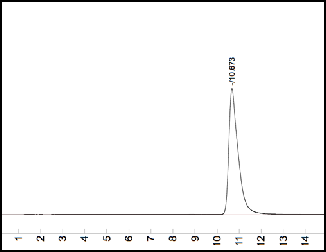
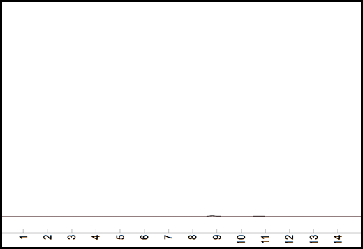
We compared 2 chromatograms: one with the UV lamp on (Fig. 3) and one with the lamp off (Fig. 4). Both were otherwise identical. The chromatogram with the light off had only small peaks at 8.79 and 10.71 minutes with integrated areas of 74.35 and 17.61 respectively. The chromatogram with UV light on in contrast had a very substantial peak at 10.67 min with an integrated area of 20595. Thus the 10.70 minute peak in the light off chromatogram (Fig. 4) has increased 1169 fold due to the photolysis as shown in the light on chromatogram (Fig. 3). We can estimate the limit of detection (LOD) considering that the noise level is circa .25 millivolt and the LOD should consequently be
.75 millivolt. Since a 10 microliter injection of a 1 millimolar solution gives a response with a peak height of 708 millivolt the LOD should be circa 0.1 micromolar. Using larger injections would increase the sensitivity of the analysis.
Conclusions:
Post column oxidative photolytic derivatization of PLP allows for a highly sensitive and selective method of analysis without the need of chemical derivatization.
Figure 1. a. Aura Industry PHRED™ Photochemical Reactor for Enhanced Detection unit.
b. Stainless steel bottom casing with knitted reactor coil inside. c. Lamp holder
outfitted with a 254 nm low-
Figure 3. Chromatogram of Vit B6 with PHRED light on. (Scale 2002 millivolt)
Figure 4. Chromatogram of Vit B6 with PHRED light off. (Scale 2002 millivolt)
Literature cited:
1. M.E. Rybak, C.M,Pfeffer, Clinical analysis of vitamin B6: Determinationof pyridoxal
5'-
2. R. Gatti, M. G. Gioia, Liquid Chromatographic Determination with Fluorescence
Detection of B6 Vitamers and Riboflavin in Milk and Pharmaceuticals, Analytica Chimaca
Acta, 538(1-
3. H. Joshua, Determination of Aflatoxins by Reversed-
4. Official Methods of Analysis of AOAC INTERNATIONAL (2005) 18th Ed., AOAC INTERNATIONAL, Gaithersburg, MD, USA, Official Method 2005.08
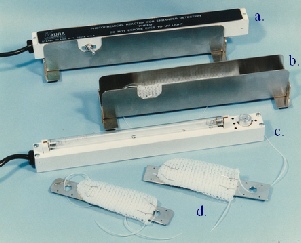
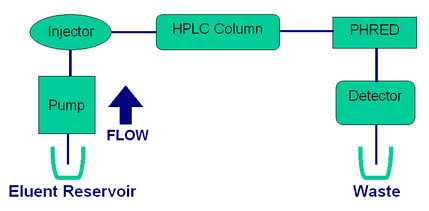
Figure 2. Schematic of Post-